Cyprus 1974: 51 years since the Ioannidis-led coup and the “Attila” invasion
Republished from Ergatiki Pali (Workers’ Struggle), July–August 2021
Historically, the Cyprus issue has been a field of conflict among Western imperialists and the aspirations of the USA, Great Britain, and, more broadly, NATO to secure the “Great Island” within their geostrategic plans, serving as an “unsinkable aircraft carrier” and a vast base to control the Eastern Mediterranean and the Middle East. Of course, the US also sought to use Cyprus as a bulwark against the USSR and its allies. In this affair, the governments of Greece and Turkey have played — and continue to play — an active negative role, due to the great geostrategic significance of the region as well as the control and exploitation of hydrocarbons.
Only nine years after the opening of the Suez Canal (1869) in Egypt, Great Britain hurried in 1878 to “purchase” the island of Cyprus from the Ottoman Empire in order to secure its imperialist designs in the Middle East and control the strategically crucial commercial and geopolitical crossroads of the Eastern Mediterranean.
After the Second World War, the US surpassed Britain — the hitherto premier imperialist power — climbing to the top of the imperialist pyramid. This change shaped a new status quo in various spheres of global influence. In the 1950s and 1960s, the global wave of anti-colonial revolutions broke out (Cuba, Vietnam, Algeria, etc.). Cyprus was not unaffected by this upsurge. The struggle for liberation from British colonialism came under bourgeois leadership, specifically the right-wing EOKA (which was also one of the outcomes of the bankrupt Stalinist policy of the Communist Party [AKEL] since the interwar period). Even though this leadership was nationalist, the base was proletarian and popular. The masses followed because the movement did not limit itself to manifestos but gave shape to the anti-colonial struggle under the pennant of enosis (union) with Greece.
In 1959 — with Britain, now weakened, finding it difficult to suppress the anti-colonial movements — the Zurich and London Agreements were signed, which nominally granted “independence.” Cyprus would have a Greek-Cypriot president, a Turkish-Cypriot vice president, a regime of tripartite supervision (Britain, Greece, and Turkey), a permanent foreign military presence, and strengthened British bases. In short, it was a mortgaged independence, a peculiar protectorate with three guardians. The same agreement provided for the deployment of a Greek and a Turkish military force on the island (ELDYK and TURDYK, respectively, 950 and 650 men). Their actions reflected the foreign policy and ambitions of Greek and Turkish capitalism respectively and were the starting point for the violent armed clashes between them that followed in 1963–64. Finally, in 1959 Cyprus held its first presidential elections, in which Archbishop Makarios was elected president of the Republic of Cyprus.
The Zurich–London agreements essentially collapsed in 1963 after Makarios attempted to change the constitution of the Republic of Cyprus. Behind this lay the ambitions of the Greek-Cypriot leadership, which sought to break with the Turkish Cypriots and strip them of their constitutional rights. It was a violent process of “Hellenization” of the island, turning it from a bi-communal state into a purely Greek one. As a result, the Turkish Cypriots withdrew from the state institutions and were confined to enclaves. Intercommunal violence intensified, making the intervention and invasion of Turkish capitalism inevitable. The government of Georgios Papandreou secretly sent a Greek division to the island with a dual purpose: to defend the interests of the Greek bourgeoisie and to carry out an anti-communist campaign.
After the collapse of the Zurich–London agreements, the American imperialists took the reins due to the intensifying Cold War. The task fell to Secretary of State Dean Acheson, who engaged in direct secret talks with Greece and Turkey. The Acheson Plan envisaged a “double union” of Cyprus, under the control of the two NATO member states and, above all, full control of the island by NATO and the US. Specifically, it proposed abolishing the Republic of Cyprus and dividing most of the island to Greece while about 10% would go to Turkey. The US hoped that Makarios would accept the plan; otherwise, he would have to be overthrown. The Greek and Greek-Cypriot sides rejected the plan, although initially the former had a positive stance. This angered the US and determined the fate of the Papandreou government (a year later, the king forced him to resign) and the coup in Cyprus ten years later.
For the dictatorship of April 21, Papadopoulos’s basic line on the Cyprus issue remained the same as all pre-junta bourgeois governments — that is, double union and, after a point, direct talks with Turkey, sidelining Makarios. The junta’s methods were undermining Makarios and above all controlling ELDYK and the National Guard to overthrow him. Both Papandreous’ government and Papadopoulos himself had prepared for this, but it was not carried out because it would provoke a Turkish intervention — something neither the Greek government nor, above all, the American imperialists wanted. In November 1973, the Polytechnic uprising changed the balance of forces within Greece. A hardline group around Ioannidis exploited this change, overthrowing Papadopoulos. Ioannidis disagreed with Athens–Ankara negotiations for any compromise solution and at the same time sought a break with Makarios, who obstructed US plans. In July 1974, after learning of the junta’s plans, Makarios openly clashed with them.
American imperialism now needed drastic solutions. To implement the Acheson Plan in practice, Ioannidis’s junta had to stage a coup in Cyprus, as an obligation to the US imperialism to which it owed its rise. The coup in Cyprus (July 15, 1974) aimed directly at overthrowing Makarios, who resisted any partition and delayed the imposition of full US and NATO control. The USSR, by contrast, supported an independent Republic of Cyprus, as it did not want to strengthen the imperialists. The Aphrodite Plan (codename for the coup in Cyprus) relied on EOKA B and the National Guard, but mainly on the latter, which was controlled by Greek officers from Ioannidis’s group.
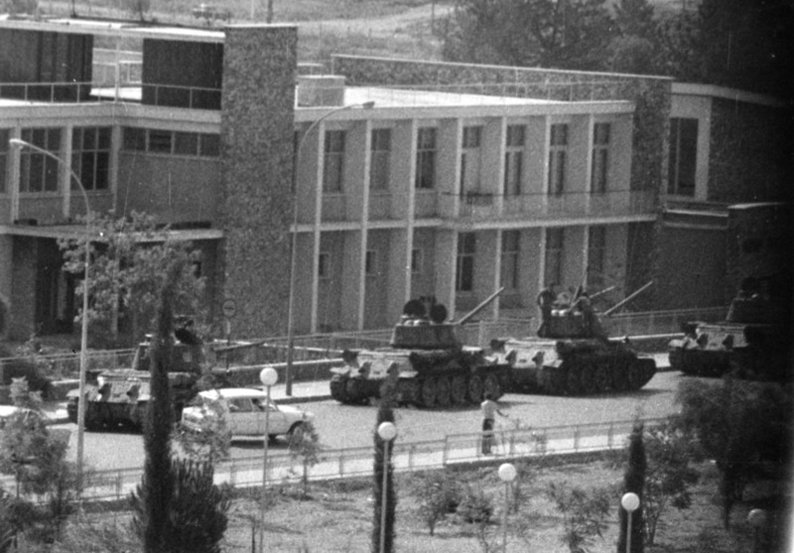
The coup began on the morning of Monday, July 15, with National Guard forces, which prevailed relatively quickly. They displayed great brutality, bombarding the presidential palace with tanks and announcing that Makarios was dead — as American imperialism eagerly wished to hear. However, Makarios survived and was evacuated to Paphos, managing even that same day to broadcast a brief recorded message from a small radio station. The Athens junta, stunned by this development, through Ioannidis ordered immediate suppression in Paphos and demanded Makarios’s “head.”
The toll of the coup in two days was 300 dead, many more wounded, and thousands arrested. That very afternoon, the junta appointed Nikos Sampson as president, known as a ruthless “Turk-slayer.” Realizing that if he stayed on the island he would be killed, Makarios fled from Paphos abroad, and four days later, speaking at the UN Security Council, he accused Athens of a foreign invasion. Technically, under the Zurich–London agreements, this gave Turkey the right to intervene — which it did on July 20, after first obtaining approval from the US and Britain.
Four days later, in a meeting between Ioannidis and US officials, American imperialism made its policy clear. The US special envoy bluntly and threateningly stated: “No war with Turkey, because you will lose, and moreover you will lose Cyprus and part of Greece. The only way out is negotiation. If you don’t listen to the US, we will abandon you.” The same day, after the Americans left, the junta attempted a general mobilization in Greece. This proved to be the junta’s fatal mistake, because the “Polytechnic generation,” overwhelmingly hostile to the junta, was called up and armed. Therefore, the mobilization was soon canceled. Ioannidis’s attempt to declare war on Turkey also collapsed due to the refusal of the military leadership, which began conspiring against him to hand power back to civilian politicians. On July 23, the junta fell, and the next day a “government of national unity” was sworn in in Athens, with Konstantinos Karamanlis as prime minister.
In Cyprus, throughout this period, the Turkish army’s invasion had unilaterally but de facto imposed partition. At the same time, the National Guard and ELDYK had effectively disbanded, while Sampson resigned. Peace talks then began, but Turkish capitalism, realizing that the Greek government would not intervene, prepared a second invasion (Attila II) a month later to change and consolidate the new balance of power on the island to its benefit. Karamanlis’s reaction, following the advice of his American “advisers,” was telling: “It is impossible to send forces to the island… due to accomplished facts.” This statement went down in history as “Cyprus lies far away.” A new period of Greek–Turkish rivalry began, in which the previous balance in favor of Greek capitalism shifted decisively against it.